The Ghost and the Darkness is a thrilling historical drama based on real events that took place in East Africa in the late 19th century. The film, directed by Stephen Hopkins, tells the story of a British engineer, Colonel John Henry Patterson, who is assigned to oversee the construction of a railway bridge over the Tsavo River in Kenya. What begins as a routine project quickly turns into a terrifying battle for survival as Patterson faces two mysterious and deadly creatures: two maneless lions, later dubbed “The Ghost” and “The Darkness.” These lions, with their unusual behavior and relentless attacks, terrorize the workers and put the entire project in jeopardy.
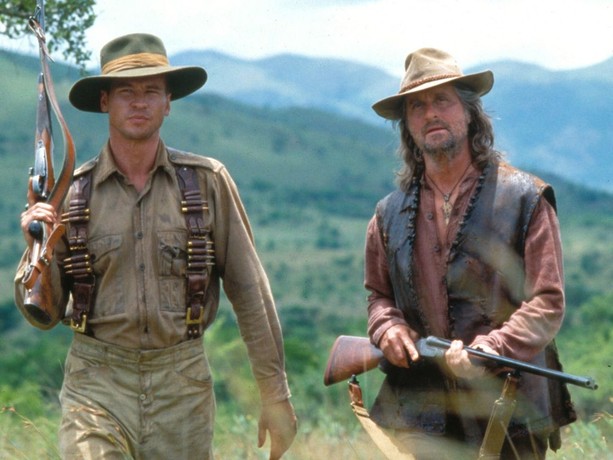
The film starts with Patterson’s arrival in Tsavo, where he encounters a hostile environment filled with local fears and superstitions. He is warned about the lions, but initially dismisses the threat as exaggerated. However, as workers begin to disappear mysteriously, Patterson starts to suspect that something more dangerous is at play. The two lions are not typical predators; they appear to be more than mere animals—they are clever, ruthless, and seemingly driven by an unknown force. The lions’ predation escalates, and their ability to stalk and kill the workers one by one plunges the camp into a state of terror.
As the death toll rises, Patterson seeks help from an experienced hunter, Charles Remington, played by Michael Douglas. Remington, a seasoned professional, joins Patterson in an effort to track down and kill the lions. Their pursuit becomes a battle of wits against creatures that seem to possess an almost supernatural intelligence. The lions are not just attacking for food—they seem to be hunting out of a deeper, more mysterious motivation. Patterson’s obsession with capturing the lions begins to consume him, as he faces his own doubts about his abilities and the looming sense of failure.

One of the film’s most gripping aspects is its exploration of fear. The lions represent more than just physical danger; they symbolize the primal fear that lurks within human nature. The workers are gripped by terror not only because of the lions’ ferocity but also because of their inexplicable behavior. The film examines how fear can distort reality and affect decisions, relationships, and even one’s sense of identity. Patterson, initially confident in his engineering skills, finds himself in a battle not just against the lions but against his own fears and insecurities.
The final confrontation with the lions is a tense and dramatic sequence. Patterson and Remington, after a prolonged and harrowing hunt, finally corner the two creatures. The culmination of the film, both emotionally and physically, comes when Patterson kills the lions in a brutal and symbolic act of triumph. However, it is clear that the victory comes at a great cost. Patterson is left forever changed by the experience, and the haunting memory of the lions lingers long after their deaths.
The Ghost and the Darkness is not only a film about survival against nature’s forces but also a psychological exploration of fear, obsession, and the human spirit. The story, set against the backdrop of the vast African savanna, reminds us of the fragile line between civilization and the wilderness, and how even the most seasoned of men can be overwhelmed by forces beyond their control. The lions, though killed, remain a lasting symbol of the mystery and unpredictability of the natural world.